


ChasquiES
Plan your visit / Your arrival in Lima

Land softly.
Start beautifully.

From the flight to your first good coffee, let the arrival feel like part of the holiday. A thoughtful plan for your first hours, with room to breathe.

Plan your arrival LESS GUESSWORK.
MORE LIMA.
Your first visit.
A good place to start.
Choose your transfer ↗Get the room dates right ↗Save your arrival card ↗
Your first hours, thoughtfully planned.

A smooth arrival starts here.

Twelve practical chapters, from the details before departure to a gentler first morning.

12 chapters to explore
See the complete contents
A traveler organising essentials while a companion notices his glasses.
Start planning / 1 min read

Before you fly: build a small arrival plan

A few clear details before the flight make the first evening much easier. Keep the plan small enough to find when you need it.

Read this chapter
Open chapterClose chapter

A good arrival plan fits on one screen. Save your flight number, arrival date in local time, accommodation address, entrance instructions, transfer booking and a contact who can help. Keep a second copy somewhere you can reach if your phone loses power. A booking confirmation that only opens through an email link is less useful when you are offline.

Pack for the first evening, not just the flight Keep your passport, essential medication, valuables, charger and one practical payment method in your cabin bag. A spare top and the essentials for an overnight stay can make a delayed checked bag less disruptive. Put a backup card in a different secure place from your daily wallet. Check your airline's cabin-baggage and battery rules before packing.

Confirm the documents for your own trip Check entry requirements for your nationality, travel document and itinerary with Peru's migration authority or the appropriate consulate. Do not use another traveller's visa status or authorised stay as your own rule. Save your first accommodation details and onward-travel information where you can show them if requested. After entry, check your authorised stay in the official immigration record.

Ask your accommodation for its full address, district, map pin and vehicle entrance. For an apartment, add the unit number, host contact and key-handover method. Share your flight number and explain any arrival needs before you leave home.

Official tourist information · TAM Virtual

Next: At the airport: give each step its turn →


Travelers identifying their suitcase by its bright ribbon.
Arrive & move / 1 min read

At the airport: give each step its turn

Follow the arrival process at your own pace. Check the bag, find your essentials and pause before your onward journey.

Read this chapter
Open chapterClose chapter

After landing at Jorge Chávez International Airport, follow the current signs and staff directions for your flight. International and domestic arrivals do not necessarily follow identical processes. Complete the controls that apply to you, collect any checked baggage due here and follow customs instructions before heading towards public arrivals.

Before you leave the baggage area Match the baggage tag and check the suitcase itself: many bags look alike after a long flight. Look for damage before leaving the area. If your bag is missing or damaged, speak to the airline's baggage team and ask how to document the problem before moving on. Keep the baggage receipt and the report reference.

Once the formalities are complete, pause somewhere you can stop comfortably. Check your phone, passport, wallet and bags. Open your pickup instructions and locate the agreed counter or meeting point. There is no prize for being the first person to leave the terminal.

Make the airport your first calm pause You only need to solve the next part of the journey: where you are going, who will take you and how you will pay. Tell your travel companions which meeting point you are using. If you need a toilet, water or a moment to regroup, do that before following your onward-transport instructions.

Older arrival videos may show different airport arrangements. Use current information from the airport and your booked operator rather than a remembered entrance or a screenshot from someone else's trip.

Airport passenger information

Next: Choose a transfer for the whole journey →
Travelers sharing a happy arrival moment at a contemporary airport.
Arrive & move / 2 min read

Choose a transfer for the whole journey

Compare the whole trip—not just its first leg. Pick the transfer that fits your time, address, luggage and travel party.

Read this chapter
Open chapterClose chapter

The best transfer is the one that fits your arrival time, exact address, luggage and travel party. Compare the complete trip, including the final walk or connection to your accommodation. A cheap first leg can be less attractive when it leaves you managing a late arrival with heavy bags.

Booked pickup or authorised airport taxi A pre-arranged pickup can simplify a long travel day. Confirm the operator, meeting instructions, full quotation, accepted payment and what happens if the flight is delayed. Ask whether waiting time is included and how the operator handles a missed connection. These are booking questions, not terms to assume.

The airport lists authorised taxi counters in domestic and international arrivals. Use its current counter information and ask for the total before accepting the journey. Staff can direct you towards the assigned vehicle area. An unsolicited offer while you are walking through arrivals does not confirm that the person represents the operator you intended to use.

Airport bus and the final connection The airport lists Airport Express services connecting the terminal with stops in Miraflores, and information about AeroDirecto public transport. Read the current route, boarding instructions, timetable and baggage terms. Check how you will get from the stop to your actual entrance—not simply to the correct district.

For a family, a mobility requirement or an overnight arrival, ask more detailed questions about luggage handling, walking distance and vehicle access. If considering an app-based ride, check the current pickup procedure in the service and make sure you can communicate at the meeting point.

Authorised airport taxis · Airport buses

Choose by the complete journey
OptionA useful fitCheck before deciding
Booked pickupA direct, arranged arrivalMeeting point, waiting terms, full total
Authorised airport taxiArranging a ride at the terminalOfficial counter, destination, payment
Airport busA matching route and manageable final connectionCurrent timetable, luggage and onward trip
Next: Meet the right vehicle, then settle in →
A traveler and driver confirming a booking beside a parked car.
Arrive & move / 1 min read

Meet the right vehicle, then settle in

A matching booking, driver and vehicle are the start of a comfortable journey. Confirm the details before boarding.

Read this chapter
Open chapterClose chapter

Keep your booking open when you reach the meeting point. Confirm the operator, driver and vehicle through the channel you used to book. For an app-based journey, compare the driver's name, photo and plate with the actual person and car. A similar vehicle or a familiar hotel name is not enough to resolve a mismatch.

Before the door closes Confirm the exact destination and entrance, the agreed total and how payment will be made. Ask about anything that is still unclear before departure. Keep your passport, phone, payment method and essential medication with you. Check that all bags and members of your party are accounted for before leaving the pickup area.

If the details do not match, remain at an appropriate staffed location and contact the operator directly. Avoid following a new set of instructions from someone whose connection to your booking has not been confirmed.

A comfortable journey into the city Use the seat belt and make sure any child restraint you require has been arranged. Keep valuables discreet and avoid leaving a phone or bag within easy reach of an open window. Send a short arrival update once you are safely settled and can do so without losing track of your things.

If the driver cannot access the advertised entrance, agree on a suitable drop-off and contact your accommodation. Ask where you will enter before unloading everyone and everything at an unfamiliar corner.

Transport and personal safety

Next: Get connected without making your phone the whole plan →
A couple checking a phone connection over coffee.
Everyday essentials / 1 min read

Get connected without making your phone the whole plan

Have a connection ready, and a plan that works without it. Download the details that matter before you land.

Read this chapter
Open chapterClose chapter

A working connection is useful; a plan that also works offline is better. Before travel, compare roaming, a travel eSIM and a local SIM. Check whether your phone is unlocked, supports the product and can keep receiving the messages you use for banking or travel accounts.

Know what your plan includes Read the activation instructions, start date, data allowance, coverage and hotspot terms. Some travel eSIMs provide data only. That does not automatically include ordinary voice calls or the same way of reaching assistance that you use at home. Keep another means of obtaining help, such as a staffed counter or reception.

For a local SIM, use an official operator outlet, take your passport and confirm the current identification and activation requirements. Requirements and available plans can change; do not plan around an informal offer made in a queue.

Download the small things that matter Save an offline map, your written address, the entrance pin, pickup instructions and the booking reference. A map pin and a street address solve different problems; keep both. Take a screenshot of access instructions that normally live behind an account login.

If you use public Wi-Fi, check the network with the venue and avoid entering sensitive information into unexpected login pages. Set up your usual transport and authentication methods before leaving home. Keep your phone charged, and carry the cable that fits your power bank.

Mobile-service information

Next: Money for the first few hours →
A traveler paying at a cafe beside a small pastry.
Everyday essentials / 1 min read

Money for the first few hours

Cover the first few practical expenses with a clear total, a payment method that works and a separate backup.

Read this chapter
Open chapterClose chapter

Aim to cover the transfer and a few immediate purchases, rather than organising your entire holiday budget while tired. Peru's currency is the sol, written S/ or PEN. Confirm the currency whenever a price is quoted, especially when a booking or transfer was discussed in dollars.

Confirm how your transfer will be paid Ask whether payment is made in advance, through the booking platform, by card in the vehicle or in cash. Keep the agreed quotation and payment record. If the method changes at the pickup point, clarify the arrangement through the operator before travelling.

A bank card is useful, but carry a backup method separately. Do not assume a local wallet will be available to you or that every small business accepts the same card brands. A little local cash in manageable denominations can make ordinary purchases easier.

Read the total before accepting At a card terminal or ATM, check the amount, currency and any displayed fees yourself. If offered a currency conversion, compare its terms with your card provider's arrangements rather than accepting automatically. Shield your PIN and put your cash away before leaving the machine.

Use an established exchange business and confirm the buying or selling rate that applies to your transaction. Count the money before walking away. If an ATM transaction fails, check the account status before repeatedly trying; save the details if you need your bank's help.

Currency in Peru

Next: A room ready for the time you really arrive →
A sleepy traveler welcomed at a warmly lit reception.
Start planning / 1 min read

A room ready for the time you really arrive

Landing after midnight? Arriving before breakfast? Make sure your booking matches the time you need a bed.

Read this chapter
Open chapterClose chapter

Check-in time, room availability and late-night access are three separate questions. Send the property your expected arrival time and ask it to confirm how you will enter. A booking system that accepts reservations all night does not necessarily mean there is a receptionist on duty all night.

The midnight date trap If your flight lands at 1 a.m. and you want a bed immediately, you may need the room booked for the previous night. Confirm the exact dates and tell the hotel you will arrive after midnight so it does not treat your reservation as a no-show. Ask what happens if the flight is delayed further.

For an early-morning landing, request early check-in in advance. If it cannot be confirmed, ask about luggage storage, restrooms and the time the room is expected to be ready. Keep essential items with you rather than in a stored suitcase you may not be able to access easily.

Know the entrance and the handover For apartments and small guesthouses, save the access code or key-handover process, the unit number and a reliable backup contact. Ask whether a phone connection is necessary to open the door. A digital lock is convenient only when its instructions work for you.

Once you are in, check the room arrangement, reception contact and building emergency instructions. Confirm breakfast times or other services you will need next morning instead of assuming they are available whenever you wake up.

Next: Make the arrival fit everyone travelling →
A family arriving at a spacious courtyard entrance.
Start planning / 1 min read

Make the arrival fit everyone travelling

A smooth arrival looks different for each group. Make space for luggage, children, access needs and the energy of the whole group.

Read this chapter
Open chapterClose chapter

Small details can matter more than the name of a transport service. Tell your operator the number of people and the amount of luggage, including a folded wheelchair, stroller, sports equipment or other bulky items. Ask for confirmation that the vehicle can accommodate them.

Describe access needs precisely Ask about the whole route: pickup point, distance to the vehicle, entry height, space inside, hotel threshold, lift access and route to the room. A photograph of a ramp or the phrase “we have a lift” does not answer every part of that journey. Request measurements or specific photographs when those details are important to you.

If assistance is needed at the airport, contact your airline in advance to confirm the service and how to request it for your flight. Keep equipment requirements and any medical needs clearly communicated. Leave enough time to move at a comfortable pace.

Travelling with children or a mixed-energy group Arrange an appropriate child restraint before the transfer and confirm how it will be supplied. Keep snacks, drinking water, a light layer and anything needed for the first evening in an accessible bag. Adults can become tired too: decide who is handling the booking and who is keeping track of luggage.

Build in a toilet break and a place to regroup. For a group arriving on different flights, agree on a meeting process rather than assuming everyone can wait in the same restricted area.

Airport accessibility and assistance

Next: When the arrival plan changes →
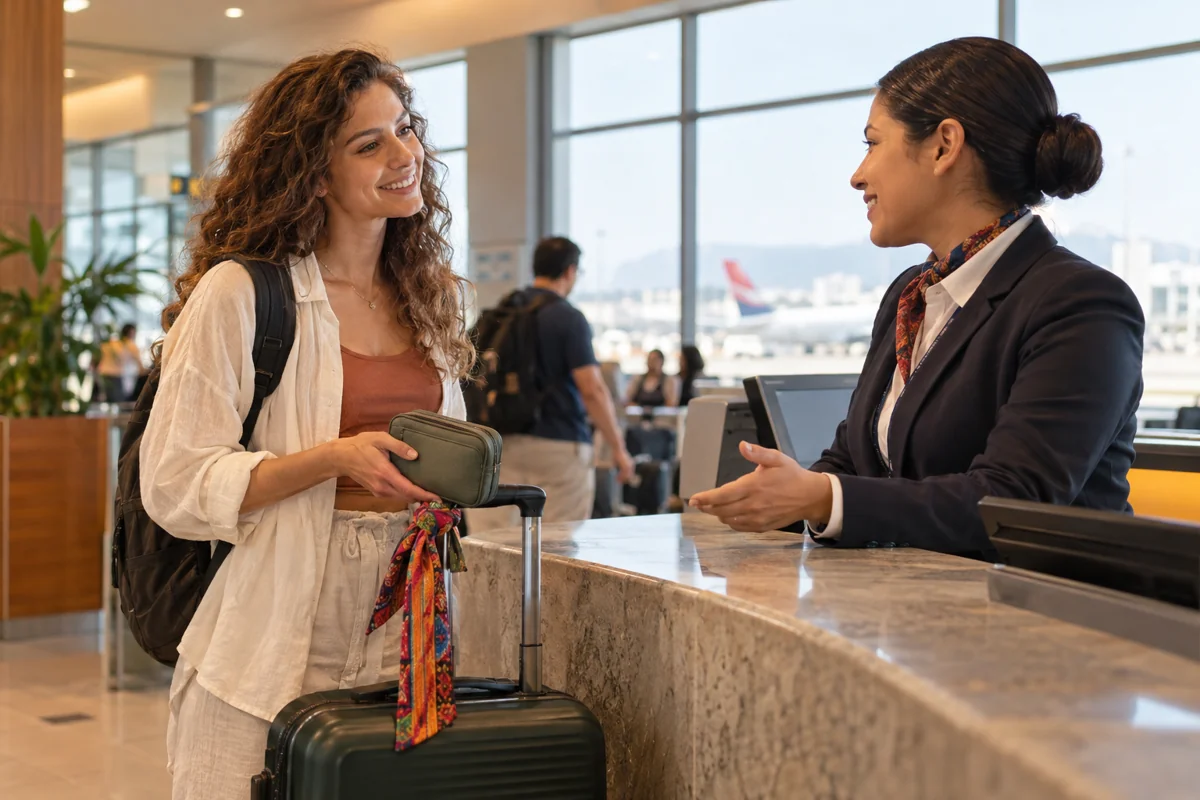
A traveler receiving help at an airport assistance desk.
Everyday essentials / 2 min read

When the arrival plan changes

If the flight, bag or pickup changes, focus on the next useful step. Start from a staffed place and your verified contacts.

Read this chapter
Open chapterClose chapter

Flights run late, phones lose power and luggage sometimes arrives separately. A useful backup is a sequence of next steps, rather than a promise that nothing will go wrong. Start from a staffed place and use the airline, hotel or operator contact you already verified.

Delayed flight or missed pickup Tell your accommodation and transfer operator when you have reliable new information. Ask for revised instructions, waiting terms and the next available arrangement. If you cannot find a booked driver, contact the operator before accepting a replacement from someone who approaches you.

A missing bag or payment problem For missing or damaged luggage, speak to the airline's baggage team, obtain the appropriate report and confirm the follow-up process. Keep the baggage receipt, reference, contact details and the delivery address you supply. Ask what documentation is needed for any necessary purchases before assuming they will be reimbursed.

If a card fails, use your separate backup and contact your bank through its official channel. Do not hand your card or unlocked banking app to a stranger offering to fix the problem. If your phone is unavailable, show the written hotel address and ask a staffed desk to help you reach your booked operator.

An item left in the terminal A forgotten object in the terminal is a different matter from a suitcase missing from a flight. Use the airport’s official lost-property process for the former, and the airline’s baggage team for the latter. Describe the item accurately and keep the reference you are given. Confirm identity checks and collection arrangements through the official channel.

Airport lost property

A closed door at the accommodation Use the saved access instructions, call the backup contact and remain somewhere appropriate while arranging help. If the booking cannot be honoured, keep messages and receipts and contact the platform or property for the next steps. A tired late-night arrival is a good reason to choose a clear, confirmed alternative.

Next: Keep the first evening close and comfortable →
Friends enjoying an easy first-evening meal.
Explore & enjoy / 1 min read

Keep the first evening close and comfortable

A nearby meal and a little breathing room can be a wonderful first evening. Save the big itinerary for a day you can enjoy it.

Read this chapter
Open chapterClose chapter

Your arrival day already contains a journey, airport procedures and a transfer. A good first evening can be a nearby meal, a little orientation and enough sleep. It does not need to make up for the hours spent in the air.

Put flexibility ahead of a perfect schedule Avoid placing a costly, tightly timed reservation immediately after the flight's scheduled arrival. Immigration, baggage, traffic and room access can all affect the day. If there is an experience you particularly care about, give it a later place in the itinerary where you can enjoy it properly.

Ask your accommodation about nearby food options and their actual operating hours. Choose a route that fits your energy and ask locally about the return. If staying in sounds more appealing, find out what delivery or hotel dining arrangements are available before you settle down.

A small reset helps Buy factory-sealed drinking water or use a source you know has been adequately treated. Wash your hands before eating and choose food handled and served appropriately. Pack a light layer for a coastal evening and comfortable shoes for any short walk. Save your exact return address before going out.

If the whole group is tired, make the next decision smaller. You can have a memorable first meal without crossing the city. There will be time for a longer lunch once you have found your rhythm.

Food and drink precautions

Next: Your first morning: learn your own neighbourhood →
Travelers enjoying a gentle first-morning walk.
Explore & enjoy / 1 min read

Your first morning: learn your own neighbourhood

Learn the streets around your stay before crossing the city. Build a relaxed first outing, and plan the journey back separately.

Read this chapter
Open chapterClose chapter

Begin with the place where you are staying. Have breakfast, locate the entrance you will use for pickups and find a convenient place to buy drinking water. Ask reception about the immediate streets, crossings and routes you are considering rather than relying only on the reputation of a district.

Choose one satisfying first outing For a short stay, decide which experience matters most and build around it. Check the actual address, opening arrangements and any reservation requirements. Group nearby stops and leave space between timed commitments. A manageable morning helps you learn the city without turning it into a race.

Coastal parks, cafés and a nearby cultural visit can make a pleasant introduction when they fit your base. Check the weather and the route. An ocean view does not automatically mean easy beach access, and a line on a map does not show every step or crossing.

Start the return plan while there is time Before your departure day, work backwards from the airline's recommended airport arrival time. Add checkout, collecting luggage, reaching the pickup point and the road journey for that day and time. Leave room for disruption.

Do not reuse the duration of your airport-to-hotel transfer as a promise for the reverse trip. Ask the operator or property about local conditions, confirm the airport drop-off instructions and recheck the route on the day. Planning the final journey early gives the rest of the visit more breathing room.

Continue with Lima Travel Guide

Next: Your arrival card: save the essentials →
A travel notebook and breakfast ready for an unhurried departure.
Everyday essentials / 1 min read

Your arrival card: save the essentials

Your flight, room, pickup and payment details in one compact place. Save it offline or print it before travelling.

Read this chapter
Open chapterClose chapter

Keep this compact record available offline. Fill in the details that apply to your trip and share the practical plan with your travel companions. The version you save should contain the actual entrance, contact and booking details—not only the name of a hotel or district.

My arrival details - Flight and local arrival date: ____________________ - Accommodation and exact entrance address: ____________________ - Check-in time and late-access instructions: ____________________ - Transfer operator and booking reference: ____________________ - Agreed meeting point and backup contact: ____________________ - Confirmed total, currency and payment method: ____________________ - Luggage, child-seat or access arrangements: ____________________ - Travel insurer and assistance contact: ____________________

Before leaving the airport Check passport, phone, payment access and every bag. Find the meeting point through your booked or official channel. Confirm the actual driver, vehicle and destination. Let the accommodation know if your timing changes. Keep essentials with you and leave the first evening flexible.

A few useful words “Necesito ayuda” means “I need help.” “¿Puede escribirlo?” means “Can you write it down?” “¿Dónde está este punto de encuentro?” means “Where is this meeting point?” Show the written address or booking when explaining what you need.

If there is an urgent problem, ask staff for immediate assistance and use the appropriate official service. Keep your insurer's contact and your country's consular information saved before travelling; a data-only plan may not let you place an ordinary phone call.

Useful sources →
Useful sources & travel checks +

Use official airport, migration and operator information to confirm the details for your flight and dates. These pages were reviewed on 17 October 2026.

Practical details reviewed 17 October 2026. Check live requirements, opening arrangements and transport instructions for your dates.

Make it your Lima.

A welcome worth
planning for.

Tell us your flight time, where you are staying and who is travelling. Let’s work through the arrival details together.

Message Chasqui on WhatsApp ↗
leave a little room…
For a slower first morning.
A good breakfast.
The Lima ahead of you.
Next: explore Lima Travel Guide →

A practical companion for your first hours in Lima. Adapt the plan to your flight, accommodation and needs. Save this HTML for offline reading; external sources, bookings and WhatsApp need an internet connection.